By: Yellena
When I first encountered the prophecy of Ezekiel in the pages of the Hebrew Scriptures, I was struck by the intensity of his visions, the drama of his symbolic actions, and the raw honesty of his message. Who was this man? What type of prophet was he? And why does his ministry still speak to us today?
In this article I invite you to journey with me into the life and calling of Ezekiel – his background, his prophetic style, his message, and the significance of his ministry for both his own time and ours. My hope is to offer not just a dry academic survey, but an engaging, personal exploration of a prophet whose voice echoes across the centuries.
Background: Priest, Exile, and Unlikely Prophet
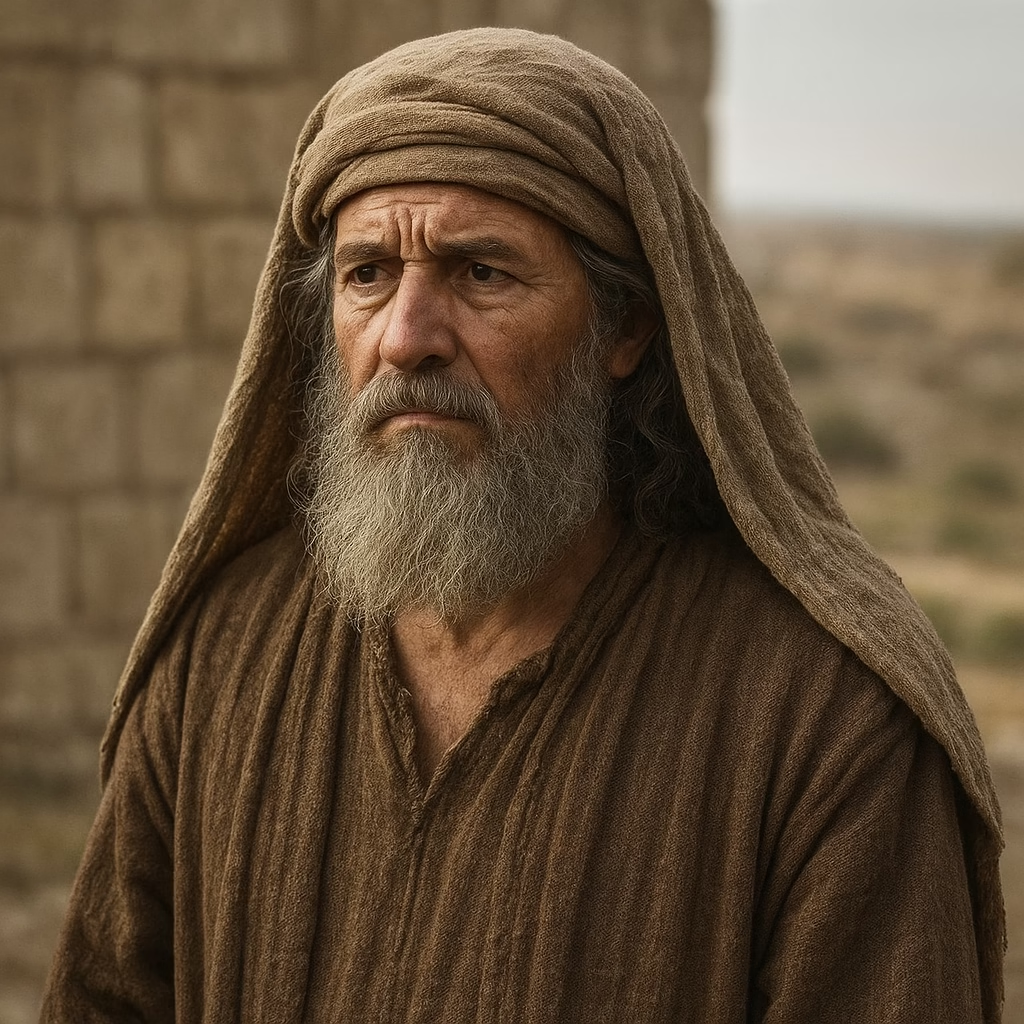
Ezekiel was no ordinary prophet. According to the biblical record, he was a member of the priestly line (his father was named Buzi) and was among the exiles taken to Babylon in the first wave of deportations (597 BCE) from the southern kingdom of Judah.
He finds himself in a foreign land, by the river Chebar, among fellow captives, uprooted from his homeland and temple service. The famous superscription of his book says:
“Now it came to pass in the thirtieth year, in the fourth month, in the fifth day of the month, as I was among the exiles by the river Chebar…” (Ezekiel 1:1)
This location and setting matter deeply: he is living exile, among a people disoriented, traumatized, stripped of their land, temple, and security. In that context, Ezekiel is called into prophetic ministry, not from the comfort of Jerusalem’s temple, but in a diaspora settlement.
Because of his priestly background, Ezekiel brings to his prophetic work a distinct lens: he knows the temple, the rituals, and the sense of sacred space. But he also knows the pain of exile and defilement. In his ministry we see a merging of priestly concerns (temple, worship, holiness) with prophetic concerns (judgment, hope, divine presence).
So we begin with: Ezekiel was a priest-prophet, located in exile, commissioned by God at a time of national crisis. That dual identity helps us understand the type of prophet he is.
Calling and Commission: A Vision, a Mission, a Warning
One of the defining features of Ezekiel’s ministry is his powerful calling vision. Early in the book (chapter 1–3) he sees the “throne‐chariot” vision: storm cloud, four living creatures with four faces each (human, lion, ox, eagle), wheels within wheels, and above it all the “glory of the Lord”.
This vision is striking, and it signals several things:
- God is sovereign, majestic, and present even in exile.
- prophet is called to be a mouthpiece, not simply a commentator.
- The world is bigger and more cosmic than the immediate exile crisis, his visions point to ultimate realities.
Beyond the vision, Ezekiel receives a mission: he is to speak to a people who will refuse to listen, to warn them of coming judgment, and to stand as a “watchman” for the house of Israel (see Ezekiel 33).
So far, we see Ezekiel the prophet as one with a dramatic commission: to bring God’s message both of warning and of hope, to a people in crisis.
Prophetic Style: Symbolic Actions, Dramatic Visions, Uncompromising Message
What type of prophet Ezekiel was is partly revealed by how he prophesied. His methods were unusual, vivid, and designed to make people pay attention.
Symbolic or “sign” actions
Ezekiel performs a number of symbolic acts. For example: he lies on his side for 390 days to represent the years of Israel’s sin (Ezekiel 4). He shaves his head and beard, divides the hair, burns part, scatters part, showing the coming destruction (Ezekiel 5). He cooks his bread over human dung to symbolize the pollutive nature of the siege.
These actions are not mere theatrics, they are embedded in his prophetic mandate. They underline that prophecy for Ezekiel is embodied, not just spoken.
Vivid visions
Ezekiel sees the departure of God’s glory from the temple (Ezekiel 10–11), the valley of dry bones (Ezekiel 37), a detailed vision of a restored temple (Ezekiel 40-48).
These visions serve to help his hearers (and us) see beyond the immediate: the condition of the people, the holiness of God, the hope of renewal. They stretch imagination and challenge comfort.
Uncompromising message
In his early ministry especially, Ezekiel’s message is one of judgment. He indicts Judah for idolatry, for reliance on foreign alliances, for social injustice, for defiling the temple (Ezekiel 8–11, 16, 20).
Bu, and this is vital, he is also a prophet of hope. After the devastation comes the promise of restoration: God will gather the exiles, give them a “heart of flesh” instead of a “heart of stone,” restore the temple, dwell among them forever (Ezekiel 11:17–20; Ezekiel 36–37).
So in style, Ezekiel is a prophet of both judgment and promise, combining stern warnings with vibrant hope.
Themes and Emphases: What Ezekiel Emphasised
To understand what type of prophet Ezekiel was, we should look at his major themes, what he cared about, what he wanted his people (and us) to understand.
Holiness of God & divine presence
Ezekiel reminds his audience that God is holy, distinct, and cannot tolerate defilement. The departure of God’s glory from the Jerusalem temple (Ezekiel 10–11) is a key moment: the temple was emptied of God’s presence because of rebellion and idolatry.
Thus Ezekiel underscores that the problem is not merely external or political, but spiritual and relational: God’s people have broken covenant and misused the temple, worship, and justice.
Individual responsibility and covenant faithfulness
One of his memorable emphases is the principle of individual responsibility. Unlike earlier prophets who stressed corporate guilt, Ezekiel insists that each person is accountable: “The soul who sins shall die” (Ezekiel 18). He also reminds that the people had much light, and thus much responsibility.
Judgment of Israel and the nations
Yes, Ezekiel pronounces judgment on Israel, especially Judah, but he also pronounces judgment on surrounding nations (Ammon, Moab, Edom, Philistia, Tyre, Sidon, Egypt, Babylon). The message is: God is not simply the God of Israel, but the God of all the earth; all nations are accountable.
Hope and restoration
Perhaps one of the most distinctive things about Ezekiel is the hope he proclaims. After the darkness comes light. The vision of the dry bones, the new covenant, the restored land, the temple, all point to renewal. “I will give you a new heart and put a new spirit within you” (Ezekiel 36:26).
Living in exile
Ezekiel’s entire ministry takes place in the context of exile. That fact shapes his perspective: the people are not just in trouble, they are uprooted, cut off from their homeland, uncertain. His prophecy is for those in diaspora, living the tension between what has been lost and what might yet be gained.
What Type of Prophet Was Ezekiel? – A Summary Portrait
Putting it all together: what kind of prophet was Ezekiel? Here’s my summary:
- Priest-Prophet: He came from the priestly line, connected to the temple service, yet he functions as prophet. His concerns with worship, holiness, temple, sacrifice reflect that priestly background.
- Exilic Prophet: He ministered in exile, among captives by the river Chebar in Babylon, speaking to a people stripped of land and temple. That context gives his message urgency and sorrow.
- Prophet of Judgment and Promise: His message is dual: fierce in its warnings and uncompromising in its indictments, yet also vibrant in its vision of restoration. He doesn’t leave his people in despair, you cannot properly grasp him by focusing only on one or the other.
- Symbolic and Visionary Prophet: His ministry uses dramatic signs, visions, symbolic acts. The imagination matters. He sees the heavenly throne-chariot, the valley of dry bones, the departure and return of God’s glory.
- Prophet of Holiness and Covenant: His heart is that God’s people live out the covenant faithfully, respect worship, avoid idolatry, recognise individual and communal responsibility, and turn to God.
- Prophet for the Long Haul: His prophecies look beyond immediate events to future restoration, not just the return from Babylon, but the ultimate hope of God dwelling with his people in full.
In short, Ezekiel is not a “nice” or “tame” prophet. He is bold, disturbing, hopeful, all at once. He challenges complacency, provokes reflection, and invites hope.
Why Does Ezekiel’s Prophecy Matter for Us Today?
You might ask: why should we care about Ezekiel in 2025? I believe his ministry has several enduring lessons.
Facing the reality of brokenness
Ezekiel forces us to confront the fact that even those who have covenant advantages (like the people of Israel) can fall into idolatry, injustice, complacency. He reminds us that the presence of God is no guarantee of our own blamelessness.
Holding judgment and hope together
In our culture, we often emphasise one or the other: either judgment (doom and gloom) or hope (everything will be fine). Ezekiel refuses to let us have just one. He sees the brokenness, and he also sees the promise. We need both.
Worship, community and identity in exile
Many people today feel like exiles: uprooted, fragmented, disconnected from tradition or homeland or community. Ezekiel’s context speaks to us: a people living away from home, longing for something more. His message invites us to live faithfully in that tension.
Imagining renewal
The vision of the valley of dry bones (Ezekiel 37) says: even what seems dead can live again. For personal faith, for communities, for societies, this is a hopeful image. God breathes life.
God still calls odd-prophets
Ezekiel was not comfortable, mainstream, or easily ignored. He performed bizarre acts, spoke shocking words, and yet he shows that God often uses unexpected people in difficult times. Ezekiel says: there is a place for you.
Challenges and Critiques
Of course, no prophet is without controversy or difficulties in interpretation. With Ezekiel, some challenges that scholars and believers raise:
- Symbolic complexity: The visions and sign-acts are so vivid and sometimes bizarre that interpretation is difficult. Some symbols may be culture-bound.
- Historical versus future fulfilment: Some of Ezekiel’s prophecies appear to have a first-century or even end-times orientation (for example Gog and Magog in Ezekiel 38-39). How we map those remains debated.
- Temple vision and literalism: The last part of Ezekiel (chapters 40-48) describes a detailed temple and land allotments. Some ask: is this literal? Symbolic? How do we apply it today?
- Prophet vs. author: The book is attributed to Ezekiel, but like many biblical books, questions of redaction, editorial layers, and later additions exist.
Nevertheless, these difficulties do not negate the value of Ezekiel’s ministry, they invite us into deeper reflection and humility.
Personal Reflection: What I Learned from Ezekiel
As I’ve immersed myself in Ezekiel’s story, I found several personal take-aways:
- When life feels uprooted (like exile), faith isn’t cancelled, it just shifts. God’s presence goes with us.
- I need to face the “temples” of my life, what I revere, what I trust, what I neglect. Ezekiel reminded me that sometimes the hardest work is inside.
- Hope is not naive optimism. It comes after the vision of destruction, after the sobering of sin, then emerges. That ordering matters.
- Prophecy is not only about predicting the future, it’s about calling people back to relationship, pointing them to holiness, dwelling with God.
- I might be called to strange things in my context, symbolic acts may not be literal, but boldness in word and deed might still be required.
Conclusion: The Legacy of Ezekiel the Prophet
So, what type of prophet was Ezekiel? He was many things: priest-prophet, exile-prophet, visionary-prophet, judgment-and-promise-prophet. He stands out in the prophetic tradition for his dramatic style, his theological depth, and the way his message spans crisis and hope, destruction and restoration.
His legacy is rich: he helped his people understand that God’s presence is not confined to a building, that holiness matters, that exile need not be permanent, that divine restoration is real. For the broader faith tradition, his influence extends into Jewish thought, Christian theology, and even inter-faith discussions (e.g., the figure of Dhū al-Kifl in Islam is sometimes associated with Ezekiel).
As you reflect on Ezekiel’s life and ministry, I hope you’ll see in him a vivid example of what it means to be called by God in hard times, with clear vision, bold action, unflinching truth, and resilient hope.
Thank you for reading. May this exploration of Ezekiel provoke fresh thought in your own journey of faith, calling, and transformation.